

Adrasteia: Chapter 12
[Note: this fiction contains occult themes, language, drug use, and crime]

If there was one thing that she knew in her heart of hearts; hot fresh coffee could work wonders for icy cold floors and soaked pajamas. . .
Another dream—another nightmare. They were becoming more vivid and intense. A visitation of sorts, from another time or place. From an entity that insisted upon being heard. All this, while she felt the slow erosion of her faith, day after day, as this case—grew increasingly complex, eerie, and vexing—in equal parts.
Regina spent the weekend buried in files at the kitchen counter, the boys darting through the house like restless shadows. Statements, interviews, handwritten notes—she reread everything, highlighter in hand, the faint scent of popcorn and boy-sweat lingering in the air. One testimony, from one close family friend, stood out now with disturbing clarity: Jillian’s mother, Brandolyn Griswald, who’d died of an apparent overdose, had been involved in some very dark things.
Whispers. Rumors. A Satanic church in the city. Monday, Regina decided, she’d pay them a visit. She made the call that morning—calm, professional—and scheduled a meeting with their enigmatic figurehead.
In quieter moments, she sat at the kitchen window, eyes flicking between her files and the backyard, where Josh and Riley tossed a football under the bright autumn sun, and frolicked around the pond. It was there her mind wandered. Reflection came easy in stolen moments like these.
Yes, she could’ve been bitter—over the cheating, the divorce, the emotional fallout. Clay had always wanted her to fit a mold: smiling homemaker, warm pie in the oven, perfect hair in place. “Susie cookie-baker,” as he once joked. But that had never been Regina. Never would be.
She didn’t know how to be vulnerable or weak, having lost her mother at so young an age. There had been no time to weep, being passed around by relatives, as her father dealt with his own grief. She didn’t know how to make herself smaller just so other people would accept her. She didn’t know how to play a role that didn’t feel absolutely genuine. She didn’t know how to please men and make them feel important. To curtsy, to smile. To wear frilly dresses or play the game. She was too busy trying to keep her own head above water—just trying to survive.
By the time Clay came along, she didn’t need rescuing. Maybe that’s why he liked her so much, in the beginning. Her build was strong and athletic, honed from years playing field hockey in the sun. She possessed an unyielding spiritual constitution. Her beauty was like the mountains; it was both subtle and startling; equal parts rugged and serene. She didn’t need makeup. She possessed natural beauty. The echoes of the strong, capable woman she would one day become were apparent, even in high school.
It was a combination that most men would have found intimidating; intelligence, attractiveness, unyielding strength of character—but not Clay. He’d been all but mesmerized. She’d been like a wild horse that had begged to be broken. Only he learned too late, it was not to be so.
It had been something of a shotgun wedding, as they’d been unable to keep their hands off of each other. Two magnets drawn together, and nine months later Josh arrived, blissfully healthy—-but the real problems started.
She never forgot what he said after he came clean and disclosed his affair. He said, I can leave now—-and I know you’ll be alright. But Ashley won’t be. She isn’t made out of the same stuff, Gina. She needs me. I’m sorry, I have to go.
To say that it had been a crushing blow would have been an understatement. She didn’t smile for a whole year after he left. He assumed that because she didn’t readily show emotions that she couldn’t be hurt. But she was. Deeply.
Years passed. In time, she managed a sort of forgiveness in her heart, although outwardly she kept it to herself. They’d invested in a ruse of cordiality towards each other, to spare their children from the hurt.
One day, she realized that perhaps he’d been right.
She needed to be something real, not someone curated. She’d never been able to be anything other than just Regina. He desperately wanted someone who needed him; love was an occupation, not just a feeling. And though it had taken years, she was finally at peace with that. In fact, she was thankful that it had ended. It meant she could finally stretch inside her own skin.
Josh poked his head in the doorway.
“Hey Mom, wanna come outside?” He arched an eyebrow, observing papers everywhere.
“In a minute.” She spoke distractedly, lost in thoughts.
“I say we barbeque!” Riley piped up, bounding in the door.
“Yeah, we could do that. The wiggly worms are getting restless.” Regina stretched, smiled and gently closed a file. She could always burn the midnight oil later.
“Yeah—for food!” Josh laughed.
Regina clapped her hands loudly once, as if coming up with a game plan. “Okay, you guys grab the burgers from the fridge. I’ll make the sides.”
“With your famous coleslaw?!” Riley exclaimed.
“Yes, with coleslaw.” Regina added, mildly.
“And baked beans?” Josh bargained.
“Only if you don’t burn the burgers this time.” Regina added, maternally.
“Solid.” Josh said, sealing the deal.
Riley giggled. All they wanted was some real mom-time. You couldn’t blame boys for wanting food and attention—especially when the world outside was starting to feel unsafe again.
So, the weekend passed in flashes: barbecue smoke curling through the trees, the boys cheering at football games on TV, video games echoing from the den, and slow walks along winding trails, the Catskills painted in a fiery blush of fall. Regina tried to enjoy it—this brief pocket of normalcy.
But it was difficult—-to enjoy the idyllic—-with danger lurking close by.
Later, the boys fell asleep in front of the TV, sprawled on the couches, half-buried in blankets and popcorn crumbs, monster movies flickering across their faces. She’d let them stay up too late. She always did when she knew it might be a while before she saw them again.
Perhaps she was too indulgent. Maybe that was her only soft side.
At 11:30 PM, Regina stretched at the counter, her eyes dry from reading. She closed the last file with a dull thunk, looked out at the darkened yard, the trees stretching skyward like cold fingers.
She stepped out onto the porch and tilted her face to the stars.
Where are you, Jillian?
There was no answer—only the hush of leaves and the low hum of something out there, waiting.
Victim #4 Mary Alice French. Age 8. Monroe County Coroner’s report: November 21, 1989.
A cold case file.
Her body was recovered in the woods off of Route 40 by two hunters. She was one of two victims who was recovered within hours of expiration, unlike a handful of others who were found in various states of decay.
It wasn’t always possible to pinpoint a cause of death, not in advanced states of decomposition. Sometimes only the bones remained, some hair, and teeth. Perhaps some remnants of clothing, if animals hadn’t gotten to it.
In Mary Alice’s case, it had been different.
She’d been wearing a white nightgown, not hers. No wounds, other than superficial, as though she’d been running through the woods. Small abrasions, scrapes on her arms, legs and feet. Too many.
Suggesting she ran, perhaps a great distance.
Cause of death: Ventricular fibrillation.
She had a heart murmur? And didn’t know it?
She checked the files. Two previous victims recovered: evidence of opioid toxicity. It didn’t fit with the others. The toxicology report on the French girl refuted the presence of opioids in her system.
Ventricular fibrillation. She died of. . . fright?
RINGGGGGGGGGG———-!
Regina jumped out of her desk chair and almost her skin.
It was already well past midnight when the phone rang.
She picked up the receiver, hand slightly trembling.
“Hello?” She whispered into the receiver, so as not to wake the boys.
“I’m outside.” It was Rod’s voice.
She peered through the blinds. Sure enough, his squad car was there.
“How’d you know I’d still be awake?” She whispered.
“Because I know you.” He replied matter-of-factly. “Now, open the door—- I’ve got a lead—-and believe me you’ll want to hear this.”
Saturday morning arrived with cold and brittle threads of field grass spotting the roadsides of Monroe County, the kind of chill that crept through gloves and settled in the bones. Bailey liked it that way. The range was usually quiet on days like this—no chatter, no bravado—just discipline and breath and the clean geometry of distance.
It was her day off. She had expected solitude.
So naturally, she was surprised to see Collins was already there. And by the looks of the shells accumulated around him, he’d been there a while.
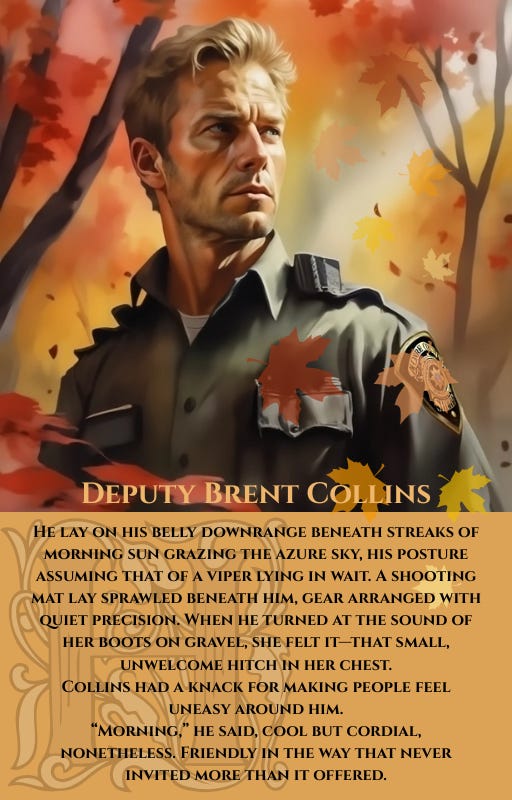
He lay on his belly downrange beneath streaks of morning sun grazing the azure sky, his posture assuming that of a viper lying in wait. A shooting mat lay sprawled beneath him, gear arranged with quiet precision. When he turned at the sound of her boots on gravel, she felt it—that small, unwelcome hitch in her chest.
Collins had a knack for making people feel uneasy around him.
“Morning,” he said, cool but cordial, nonetheless. Friendly in the way that never invited more than it offered.
“Morning,” Bailey replied, managing the same.
He bore more than a passing resemblance to a famous actor, she mused to herself. Dutch-blond hair and square jaw—faint crows feet etched at the corners of the eyes, same brutal handsomeness—but the resemblance ended there. Something in him felt colder. Not cruel. Not hostile. Just… distant. Like the wind coming off the mountains. A man who kept his inner weather to himself.
She noticed the rifle immediately.
A long-barreled sniper setup, immaculate. The one he always carried. As if a 16-pointer waited for him around every turn. He was practicing, not plinking. This wasn’t recreation—it was maintenance.
“Didn’t know you came out here,” she said.
“Not often,” Collins replied. “When I need to.”
The answer lingered in the air like frost.
She watched as he settled back into position, movements economical, practiced without showmanship. No theatrics. No bravado. He took his time adjusting the scope, assessing the wind by watching the grass in the adjacent field rustle gently in the breeze beyond the target. He paused, as if listening to something she couldn’t hear.
The first shot cracked the morning open.
The sound was sharp, surgical. The steel target rang a moment later—dead center. Collins didn’t react. He simply cycled the bolt, breathing slow, steady.
Bailey’s stomach tightened.
She had seen good shots before. Plenty of them. This was different. This was someone who didn’t miss because missing wasn’t part of the equation.
“You’re on today,” she said, careful to keep her tone light.
He shrugged. “Some days you feel it. The itch.”
“The itch?”
Collins glanced at her, just briefly. His eyes were calm, deep blue and solid, like the sky.
“When something’s coming,” he said. “You don’t know what. Or when. You just. . . know.”
A pause. A breath. He fired again.
Another clean hit.
Bailey stood entranced, watching. Trying not to make a sound. Imagining this exercise requiring the utmost precision—the utmost concentration.
For his last shot, Collins changed targets. Someone had propped a pumpkin at the hundred-yard mark—pre-Halloween, its perfect bright orange skin held intact by the chill autumn weather, no doubt a repository of countless seeds.
He chambered a round, exhaled once.
The rifle split the air with a deafening crack.
The pumpkin exploded in a wet, violent bloom—shards and pulp spraying outward in a sudden, brutal burst. The casing arced through the air, still warm, landing near Bailey’s boot.
Collins rose, calm as ever.
“Good practice,” he said, folding the stand, and collecting his gear.
Bailey stared at the remnants downrange, her breath fogging in the cold.
She wasn’t sure what unsettled her more—that the shot had been perfect…
—or that he’d seemed oddly relieved afterward.
The Shannon Falls Rest Home sat back from the road, a low brick building with narrow windows and a flag that snapped weakly in the late-autumn breeze. Regina parked and shut off the engine, resting her hands on the steering wheel for a moment longer than necessary. The boys waited, unusually patient.
Her father had been here for nearly a year now.
After the heart attack, there had been a rally—color returning to his face, jokes creeping back into his voice, the old stubbornness asserting itself as if will alone might keep his heart beating like a metronome. But lately the prognosis had changed. The nurses spoke more carefully. The good days were fewer. The bad ones lingered.
Regina hadn’t visited in a month.
Part of it was fear—simple, cowardly fear of seeing him smaller, dimmer, more fragile than the man she carried in her memory. The other part was the job. The missing girls. The sleepless nights. The nightmares. The inability to articulate it all, meaningfully, to another human being. The feeling that if she stopped moving, even for a moment, everything might come crashing down.
She hadn’t stopped moving.
Until now.
Inside, the air smelled faintly of disinfectant and overcooked vegetables. The boys flanked her as they walked the hallway, Josh quiet and watchful, Riley swinging his arms and reading every sign aloud under his breath. When they reached her father’s room, Regina slowed.
“Pops,” Riley whispered, running towards him, reverent and cheerful all at once, as if saying the name might summon him stronger.
Her father lay propped up in the bed, thinner than she remembered, the blanket rising and falling with shallow, careful breaths. The television murmured low in the corner. When he turned his head and saw them, his face lit in a way that made something in Regina’s chest ache.
“Well, I’ll be durned,” he said softly. “Look who came to see me.”
The boys were at his side in an instant, Riley climbing carefully onto the edge of the bed, Josh standing close enough to touch. Their affection was easy, unforced. Pops had never been “Grandfather”—that word belonged to men in suits and formal portraits. Pops belonged to them.
After a few minutes—small talk, school updates, Riley showing him a crumpled drawing from his pocket—Riley’s attention drifted.
“Mom?” he said. “Can I get a soda from the machine?”
Regina nodded. “Sure. You know where it is.”
She reached into her coat pocket and came up with a fistful of coins, far more than necessary, and dropped them into his outstretched hands. The metal clinked loudly in the quiet room.
“Get one for you,” she added, “and one for Josh. Take your time.”
Riley grinned, already halfway to the door. Josh hesitated, glancing between Regina and Pops, then followed his brother out into the hall.
They knew the drill by now. The door swung partially closed behind them.
Regina turned back to her father, the room suddenly too quiet, the air too thin. She pulled a chair close to the bed and sat, taking his hand carefully, as if afraid it might break.
She tried to smile. “You look—well?”
The lie hung between them, thin and unconvincing.
Her father chuckled, a dry, papery sound that still carried a trace of mischief. “I’m afraid it won’t be long now,” he said, almost with a smirk, teasing her the way he always had.
“Daddy, please don’t talk that way,” Regina scolded gently. Then, more softly she began again—-“I really don’t know what I’m going to do when—”
Her voice failed her. The word lodged somewhere behind her throat and refused to come out.
He reached for her hands, his grip weaker than it used to be but no less warm, folding her fingers between his palms. “Ohhh, you know I’m just teasing, Genie,” he said, using the old nickname. “You know I’ll never be very far away.”
Regina nodded, wiping at her nose with a tissue she’d already crushed once before. She took a breath, steadied herself.
There was a pause. He studied her then, head tilted slightly, eyes sharpening with a familiar fatherly curiosity. “There must be some other reason you’re here,” he said, “because visiting old guys with cannulas in their noses on a Sunday isn’t exactly a fun way to spend an afternoon.”
She pulled her chair closer to the bed, the legs scraping softly against the linoleum. “Dad. . . do you remember. . . that case?”
The change in him was immediate. His eyes hardened, his jaw set, and for just an instant she saw the man he used to be—the hardened lawman, the one who never flinched. It startled her how quickly it came back.
“How could I forget?” he said. “I assume you’re referring to the girls.”
“Yes,” Regina replied, trying to gather herself.
“Well?” he pressed. “Tell me there’s been a break in that case.”
She shook her head—then nodded—then stopped, unsure which was the truth she could bear to say.
“They say he’s back,” he said quietly, motioning to the TV above his head.
Their eyes locked. Something unspoken passed between them. He saw it then—the fear. Not worry, not exhaustion. Fear. And that, more than anything, unsettled him.
“He hunted those girls, you know,” her father said.
“I know,” Regina replied softly.
Wind-blown leaves rustled against the window panes in the waning afternoon sun, suggesting the chill of ever-approaching evening would not be far behind. She wasn’t sure what to say, but proceeded cautiously.
“I just wanted to know—” Regina began, then faltered. “Did anything… did anything strange happen during that time? To you?”
Her father wrinkled his brow and studied her for a long moment. “A whole lot of strange, sweetheart,” he said at last. “Nothing but strange. That whole stinking case, from beginning to end, was strange. I damn near lost my mind.”
She nodded, accepting that much, and blew softly into the tissue clenched in her hand. “Did you ever… have an odd feeling?”
“Yes,” he said without hesitation. “All the time. Because of what they did to them.”
Regina’s breath left her in a short, sharp exhale. “They?”
Her father’s gaze drifted past her, toward a far corner of the room, somewhere above her head, as though he were peeling back layers of years, reaching for something buried deep. “I’d always had the thought that it might be more than one person,” he said slowly.
He paused, then looked back at her, frustration flickering across his face. “I don’t recall why I thought that. Too many years ago.”
“Please, Dad,” she said quietly. “Anything you can remember…”
“Well,” he went on, “people hunt in packs. Like wolves. They’ve been doing it for millennia.” His brow creased again. “But there was some other reason why I thought that. I just—can’t remember.”
“It’s okay,” Regina said, squeezing his hand. “It’s okay, Dad.”
“I do remember this,” he added, through belabored breaths. “All of the suspects checked out. Nothing stood out. Except . . . a lack of evidence.”
Her heart thudded harder as she asked the question she’d been circling all along. “Did you have a gut feeling about anyone?”
To her astonishment, he answered immediately. “Yes.”
Her voice barely held steady. “Who?”
He shook his head slowly. “You wouldn’t believe me, Genie, if I told you.”
“Yes, I would,” she insisted, leaning closer now. Almost pleading. “Why wouldn’t I?”
“It was such a long shot. . . .” His voice trailed off as he began to cough—lightly at first, as if he’d simply caught his breath wrong, then deeper, harsher.
A nurse passing in the hall stopped and stepped into the doorway. “I’m sorry,” she said gently. “Visiting hours are almost over, and it’s time for his medication. I’m afraid it will make him very sleepy.”
Josh and Riley chose that moment to bound back into the room. They hugged him tightly, already understanding that it was time to go. She watched as her father ruffled their hair each, affectionately.
Regina lingered, unsettled by how unfinished the conversation felt. Her father saw it in her face. It was hardly a topic that could be discussed in front of children, or hospital staff. Yet, she begged him with her eyes not to dismiss her without answers. The nurse administered the narcotics through his IV, and the change came quickly, his features softening as the edge of wakefulness dulled.
Just before sleep claimed him, he murmured,
“Just look up, kiddo. Just look up.”
He lifted a finger weakly and tapped the headboard behind him, gesturing toward the small cross mounted on the wall above his bed.
“You can’t go wrong if you just look up.”
Then his eyes closed, and he slipped into a deep, medication-induced sleep, leaving Regina with more questions than answers.